C if Statement
The syntax of the if statement in C programming is:
if (test expression)
{
   // code
}
How if statement works?
The if statement evaluates the test expression inside the parenthesis ().
- If the test expression is evaluated to true, statements inside the body of
ifare executed. - If the test expression is evaluated to false, statements inside the body of
ifare not executed.
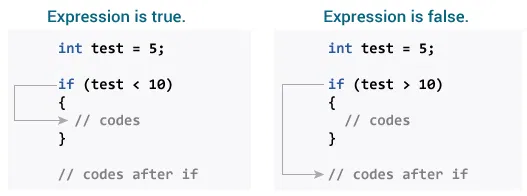
To learn more about when test expression is evaluated to true (non-zero value) and false (0), check relational and logical operators.
Example 1: if statement
Output 1
Enter an integer: -2
You entered -2.
The if statement is easy.
When the user enters -2, the test expression number<0 is evaluated to true. Hence, You entered -2 is displayed on the screen.
Output 2
Enter an integer: 5
The if statement is easy.
When the user enters 5, the test expression number<0 is evaluated to false and the statement inside the body of if is not executed
C if...else Statement
The if statement may have an optional else block. The syntax of the if..else statement is:
if (test expression) {
    // run code if test expression is true
}
else {
    // run code if test expression is false
}
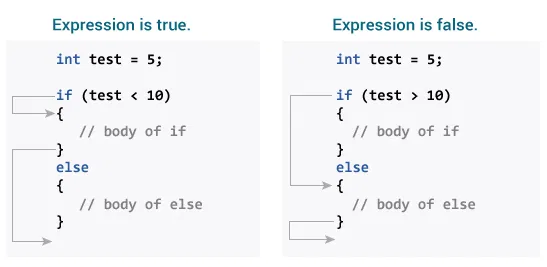
How if...else statement works?
If the test expression is evaluated to true,
- statements inside the body of
ifare executed. - statements inside the body of
elseare skipped from execution.
If the test expression is evaluated to false,
- statements inside the body of
elseare executed - statements inside the body of
ifare skipped from execution.
Example 2: if...else statement
Output
Enter an integer: 7
7 is an odd integer.
When the user enters 7, the test expression number%2==0 is evaluated to false. Hence, the statement inside the body of else is executed.
C if...else Ladder
The if...else statement executes two different codes depending upon whether the test expression is true or false. Sometimes, a choice has to be made from more than 2 possibilities.
The if...else ladder allows you to check between multiple test expressions and execute different statements.
Syntax of if...else Ladder
if (test expression1) {
   // statement(s)
}
else if(test expression2) {
   // statement(s)
}
else if (test expression3) {
   // statement(s)
}
.
.
else {
   // statement(s)
}
Example 3: C if...else Ladder
Output
Enter two integers: 12
23
Result: 12 < 23
Nested if...else
It is possible to include an if...else statement inside the body of another if...else statement.
Example 4: Nested if...else
This program given below relates two integers using either <, > and = similar to the if...else ladder's example. However, we will use a nested if...else statement to solve this problem.
If the body of an if...else statement has only one statement, you do not need to use brackets {}.
For example, this code
if (a > b) {
    printf("Hello");
}
printf("Hi");
is equivalent to
if (a > b)
    printf("Hello");
printf("Hi");