C break
The break statement ends the loop immediately when it is encountered. Its syntax is:
break;
The break statement is almost always used with if...else statement inside the loop.
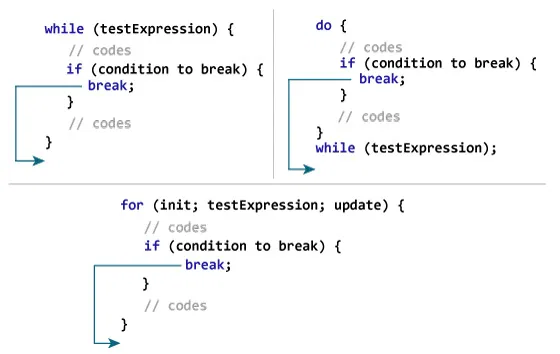
How break statement works?
Example 1: break statement
Output
Enter n1: 2.4
Enter n2: 4.5
Enter n3: 3.4
Enter n4: -3
Sum = 10.30
This program calculates the sum of a maximum of 10 numbers. Why a maximum of 10 numbers? It's because if the user enters a negative number, the break statement is executed. This will end the for loop, and the sum is displayed.
In C, break is also used with the switch statement. This will be discussed in the next tutorial.
C continue
The continue statement skips the current iteration of the loop and continues with the next iteration. Its syntax is:
continue;
The continue statement is almost always used with the if...else statement.
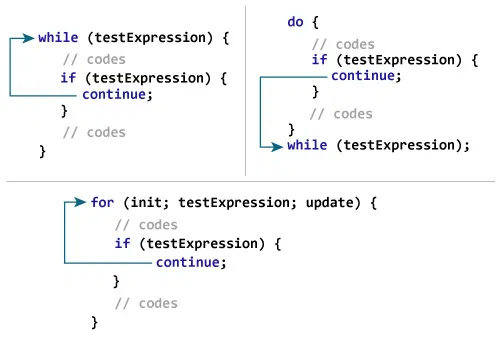
How continue statement works?
Example 2: continue statement
Output
Enter n1: 1.1
Enter n2: 2.2
Enter n3: 5.5
Enter n4: 4.4
Enter n5: -3.4
Enter n6: -45.5
Enter n7: 34.5
Enter n8: -4.2
Enter n9: -1000
Enter n10: 12
Sum = 59.70
In this program, when the user enters a positive number, the sum is calculated using sum += number; statement.
When the user enters a negative number, the continue statement is executed and it skips the negative number from the calculation.