In Swift, two or more functions may have the same name if they differ in parameters (different number of parameters, different types of parameters, or both).
These functions are called overloaded functions and this feature is called function overloading. For example:
// same function name different arguments
func test() { ... }
func test(value: Int) -> Int{ ... }
func test(value: String) -> String{ ... }
func test(value1: Int, value2: Double) -> Double{ ... }
Here, the test() function is overloaded. These functions have the same name but accept different arguments.
Note: The return types of the above functions are not the same. It is because function overloading is not associated with return types. Overloaded functions may have the same or different return types, but they must differ in parameters.
Example1: Overloading with Different Parameter Types
Output
String value: Swift
Integer value: 2
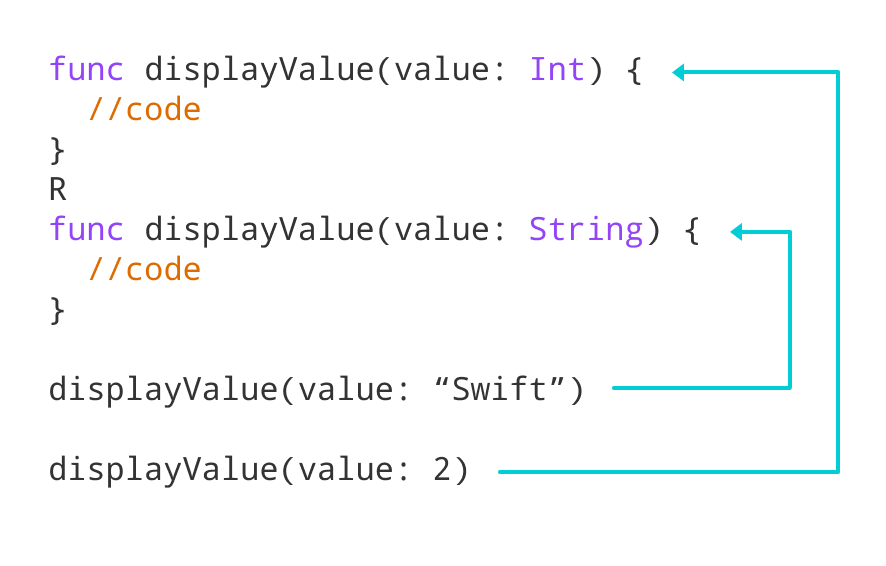
In the above example, we have overloaded the displayValue() function:
- one function has
Inttype parameter - another has
Stringtype parameter
Based on the type of the argument passed during the function call, the corresponding function is called.
Example2: Overloading with Different Number of Parameters
Output
Integer number: 5
1st Integer: 6 and 2nd Integer: 8
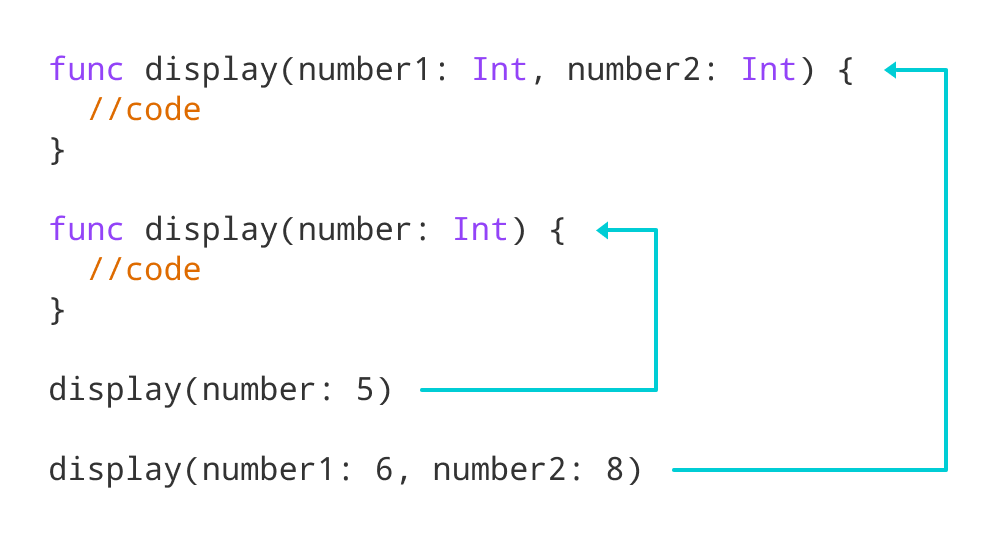
Here, we have overloaded the display() function with different numbers of parameters.
Based on the number of arguments passed during the function call, the corresponding function is called.
Example 3: Function overloading with Argument Label
Output
Person1 Age: 25
Person2 Age: 38
In the above example, two functions with the same name display() have the same number and the same type of parameters. However, we are still able to overload the function.
It is because, in Swift, we can also overload the function by using argument labels.
Here, two functions have different argument labels. And, based on the argument label used during the function call, the corresponding function is called.