In C++, pointers are variables that store the memory addresses of other variables.
Address in C++
If we have a variable var in our program, &var will give us its address in the memory. For example,
Example 1: Printing Variable Addresses in C++
Output
Address of var1: 0x7fff5fbff8ac
Address of var2: 0x7fff5fbff8a8
Address of var3: 0x7fff5fbff8a4
Here, 0x at the beginning represents the address is in the hexadecimal form.
Notice that the first address differs from the second by 4 bytes and the second address differs from the third by 4 bytes.
This is because the size of an int variable is 4 bytes in a 64-bit system.
Note: You may not get the same results when you run the program.
C++ Pointers
As mentioned above, pointers are used to store addresses rather than values.
Here is how we can declare pointers.
int *pointVar;
Here, we have declared a pointer pointVar of the int type.
We can also declare pointers in the following way.
int* pointVar; // preferred syntax
Let's take another example of declaring pointers.
int* pointVar, p;
Here, we have declared a pointer pointVar and a normal variable p.
Note: The * operator is used after the data type to declare pointers.
Assigning Addresses to Pointers
Here is how we can assign addresses to pointers:
int* pointVar, var;
var = 5;

// assign address of var to pointVar pointer
pointVar = &var;
Here, 5 is assigned to the variable var. And, the address of var is assigned to the pointVar pointer with the code pointVar = &var.
Get the Value from the Address Using Pointers
To get the value pointed by a pointer, we use the * operator. For example:
int* pointVar, var;
var = 5;

// assign address of var to pointVar
pointVar = &var;

// access value pointed by pointVar
cout << *pointVar << endl;   // Output: 5
In the above code, the address of var is assigned to pointVar. We have used the *pointVar to get the value stored in that address.
When * is used with pointers, it's called the dereference operator. It operates on a pointer and gives the value pointed by the address stored in the pointer. That is, *pointVar = var.
Note: In C++, pointVar and *pointVar is completely different. We cannot do something like *pointVar = &var;
Example 2: Working of C++ Pointers
Output
var = 5
Address of var (&var) = 0x61ff08

pointVar = 0x61ff08
Content of the address pointed to by pointVar (*pointVar) = 5
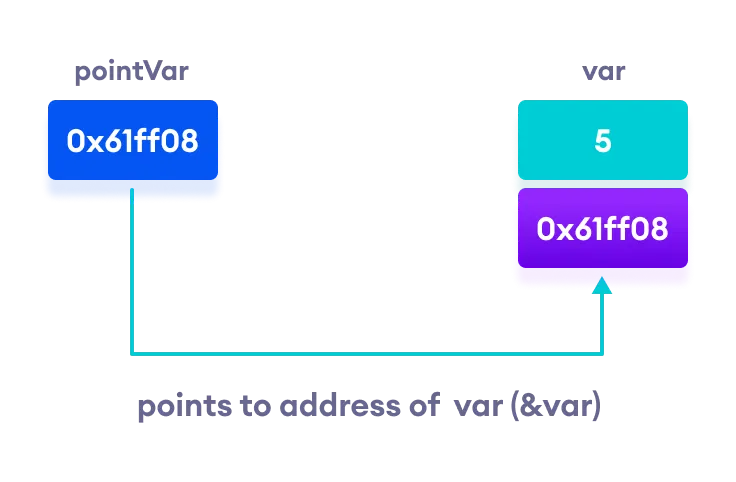
Changing Value Pointed by Pointers
If pointVar points to the address of var, we can change the value of var by using *pointVar.
For example,
int var = 5;
int* pointVar;

// assign address of var
pointVar = &var;

// change value at address pointVar
*pointVar = 1;

cout << var << endl; // Output: 1
Here, pointVar and &var have the same address, the value of var will also be changed when *pointVar is changed.
Example 3: Changing Value Pointed by Pointers
Output
var = 5
*pointVar = 5

Changing value of var to 7:
var = 7
*pointVar = 7

Changing value of *pointVar to 16:
var = 16
*pointVar = 16
Common mistakes when working with pointers
Suppose, we want a pointer varPoint to point to the address of var. Then,
int var, *varPoint;

// Wrong!
// varPoint is an address but var is not
varPoint = var;

// Wrong!
// &var is an address
// *varPoint is the value stored in &var
*varPoint = &var;

// Correct!
// varPoint is an address and so is &var
varPoint = &var;

 // Correct!
// both *varPoint and var are values
*varPoint = var;
Recommended Readings: